





If you are looking for a foot massager for polyneuropathy, you quickly end up with rankings bearing "test winner" badges. The problem: most of them come from comparison portals that sort products by manufacturer specifications and customer reviews, not by testing of their own. And even a properly tested device says nothing about whether it suits your particular symptoms. So this article does not give you a ranking, but the criteria you can use to check for yourself.
Summary/TLDR
With polyneuropathy, different things matter than with an ordinary wellness device: an adjustable intensity that is genuinely gentle at the bottom end, a heat function that can be switched off or is strictly limited, an automatic shut-off and controls you can reach without bending down. EMS devices, which work with electrical impulses, are a special case and should be cleared with a doctor first, especially with diabetes, impaired temperature or pain sensation, a pacemaker or open sores on the foot. A massager does not treat polyneuropathy. It may ease tension and abnormal sensations as a complement; the cause belongs in the hands of a doctor.
Why different criteria apply with polyneuropathy
Polyneuropathy changes how the foot reports stimuli. A mixture that seems contradictory at first glance is typical: some areas are numb and feel too little, others react hypersensitively to touch. Together, this makes the feedback you would normally rely on with a massager unreliable.
This has two practical consequences. First: you notice too late when a device presses too hard or gets too warm. The usual safeguard of "that hurts, I'll stop" may not kick in. Second: what counts as pleasantly firm for healthy feet can be far too much here.
That is why the most important feature is not maximum power, but how gentle the lowest level really is. Many devices advertise three intensity levels where even level one grips firmly. For this application, that is the wrong design.
The six criteria that really matter
| Criterion | What to look for | Why |
|---|---|---|
| Lowest intensity level | Can the device be turned down to a light vibration? | With impaired sensation, too much pressure is the main risk |
| Heat | Can be switched off separately, temperature limited | Numb areas do not reliably report heat |
| Automatic shut-off | 15 to 20 minutes, no longer | Prevents unnoticed overuse |
| Controls | Remote control or foot button instead of a button on the housing | Bending down while seated is impractical and unsteady |
| Opening and fit | Does the foot fit in without being pinched? | Pressure points are a concern with neuropathy and diabetes |
| Cleaning | Removable, washable inner lining | Hygiene, especially with sensitive skin |
The order is deliberate: the first three points are safety criteria, the last three concern everyday use. A device that fails the first three is not made better by good build quality.
EMS devices: the special case
EMS foot mats do not work mechanically, but with weak electrical impulses that stimulate the muscles to contract. They are often marketed specifically for neuropathy. That deserves a clear assessment.
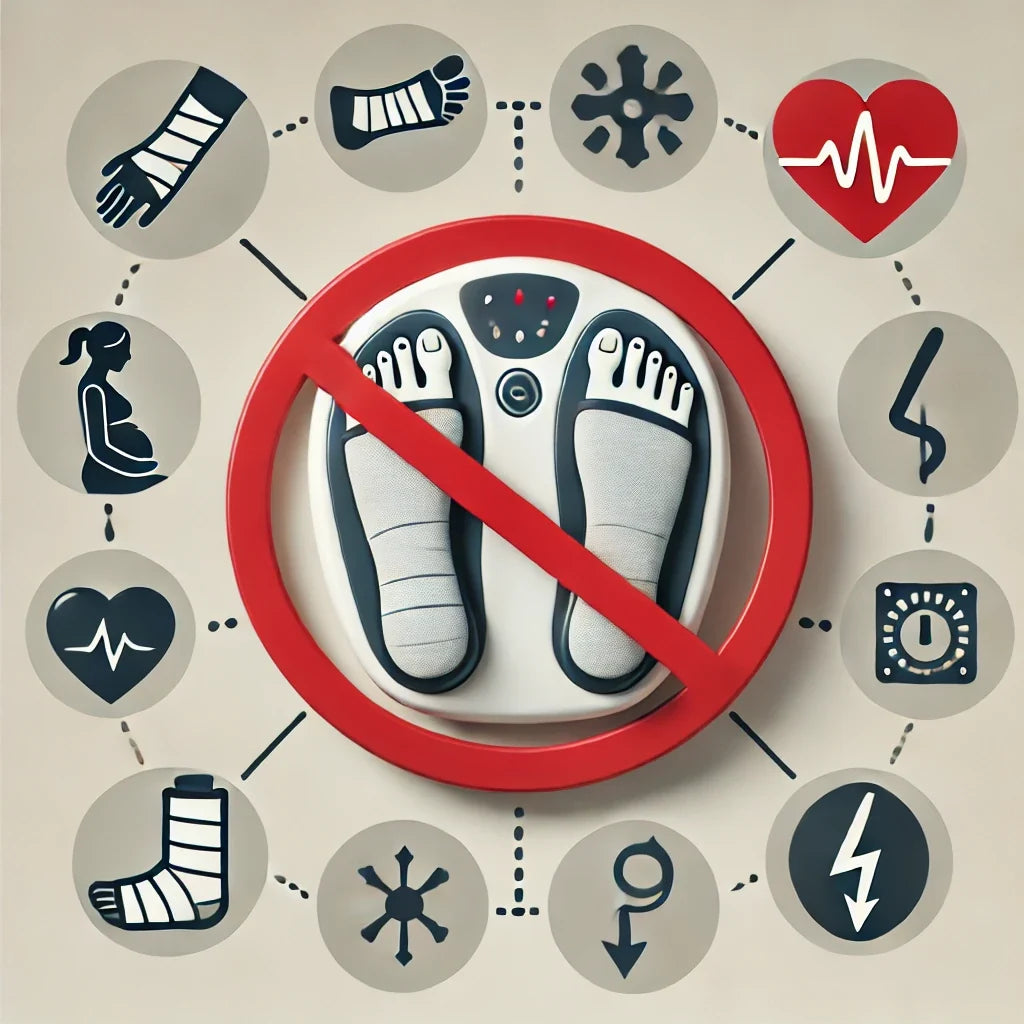
Electrical muscle stimulation is an established method, but it has real contraindications. Get medical clearance first if you have:
- a pacemaker, implanted defibrillator or other active implants
- pregnancy
- epilepsy
- open wounds, ulcers or inflammation on the foot
- diabetes with diabetic foot syndrome
- thrombosis or suspected thrombosis
Diabetes is particularly relevant with polyneuropathy, because a considerable share of cases are caused by diabetes. If the skin on your foot is already causing problems, a device of any kind is the wrong order of things. The foot clinic comes first.
Important safety notice: Not suitable for use by people with a pacemaker.
What EMS does in everyday life and how to use it is covered in detail in How to use an EMS foot massager correctly and what an EMS foot massager does. Whether it can be dangerous is covered in this article.
What is behind the test winner badges
"Test winner" is not a protected term. In this product category, most badges come from comparison portals that evaluate data sheets and reviews without handling the devices themselves. That is not worthless in itself, but it is something different from a laboratory test.
When you come across a badge, check three things:
- Who did the testing? Is there a testing institute behind it, or a portal that earns money from affiliate links?
- Was the device physically tested? Wording such as "comparison" or "best list" points to a desk-based evaluation.
- How old is the test? Model cycles are short; a badge from three years ago may refer to a device that no longer exists in that form.
If you are specifically looking for a verdict from Stiftung Warentest, the German consumer testing organisation, it is best to look directly in their database at test.de. What circulates under that name elsewhere is often not what you were looking for.
What you can safely do without
Some advertised features sound good but make little difference for this use:
- Very high kneading intensity. Intended for healthy athletes' feet, more of a drawback here.
- Many automatic programmes. In practice, most people use two or three settings.
- App connectivity. Convenient, but not a feature that affects results.
- Red light as an extra. Pleasantly warm, but no substitute for treatment.
For simply stimulating circulation, a basic device is often enough. Whether and how well that works is assessed in this article on circulation.
Water-based devices and foot spas
Bubbling foot spas are often mentioned in the same breath as massagers. With polyneuropathy, an additional rule applies here: check the water temperature with your hand, or better with a thermometer, never with your foot. The very feedback you would rely on is the one that is impaired. Scalds with impaired temperature sensation are a known problem and happen unnoticed.
More on this in Is a foot spa dangerous? and, for devices with water in general, in Foot massagers for fluid in the legs.
Use: short, gentle, regular
With polyneuropathy, the dosage matters more than the device. What has proven useful:
- Start with the lowest level and five minutes, not with the programme the manufacturer suggests
- Look at your feet after every session. Redness, pressure marks or swelling are the signal to scale back
- Better ten minutes a day than half an hour twice a week
- If tingling, burning or numbness increases, pause and have it checked by a doctor
How long a session should generally last is covered in How long can you use a foot massager?. When to leave it alone entirely is explained in When should you not use a foot massager?.
What a device cannot do
A foot massager does not treat polyneuropathy. It does not act on the damaged nerves and does nothing about the cause, whether that is diabetes, medication, alcohol or something else. What it can do: stimulate circulation as a complement, loosen tense foot muscles and, for some people, let the abnormal sensations fade into the background for a while.
That is a realistic benefit and reason enough to try it. But it replaces neither investigating the cause nor the prescribed therapy. Which types of device are suitable in principle is compared in Which massager for polyneuropathy?. The manual alternative is covered in Foot reflexology for polyneuropathy.
Conclusion
The search for the test winner usually leads nowhere in this category, because the badges are rarely what you are looking for. A short check of your own makes more sense: how gentle is the lowest level, can the heat be switched off, does the device switch itself off, can you reach the controls while seated. If you answer these four questions, you have done more for your decision than any ranking. And with EMS: doctor's appointment first, then the purchase. The devices themselves are in the overview of foot massagers.
Frequently asked questions (FAQs)
Is there a Stiftung Warentest foot massager test?
If you are looking for a verdict from Stiftung Warentest, it is best to look directly in the database at test.de. Much of what appears in search results under that name comes from comparison portals and is not a test by the institute.
Which foot massager is best for polyneuropathy?
There is no general answer, because symptoms vary too much. What matters is a genuinely gentle lowest level, heat that can be switched off and an automatic shut-off. A device that meets these three points is preferable to a highly rated one without them.
Are EMS foot massagers suitable for neuropathy?
They are marketed for it, but have real contraindications, including pacemakers, pregnancy, epilepsy, open sores on the foot and diabetic foot syndrome. Before buying, take the question to your doctor once, not to a review portal.
Are cheap devices from discount stores any good?
The price says little about suitability. Check the same six criteria as with more expensive models. More important than the brand is whether the intensity can be turned down far enough and whether the heat can be switched off separately.
How often should you use the device with polyneuropathy?
Short and regular is better than rare and long. Ten minutes a day on a low level is a good starting point. After each session, check your feet for redness and pressure marks.
Can a foot massager cure polyneuropathy?
No. It does not act on the damaged nerves and does not affect the cause. It can stimulate circulation and relieve tension as a complement. Treatment of the underlying condition belongs in the hands of a doctor.
What do I need to watch out for as a diabetic?
Temperature and pressure points. With impaired sensation, scalds and chafing are noticed too late. If you already have diabetic foot syndrome or open sores, the decision belongs with your doctor. In detail: Are foot massagers suitable for diabetics?
Which is better: a device with water or without?
For use with polyneuropathy, a dry device is the simpler choice, because the temperature question does not arise. If you want a foot spa, always measure the water temperature with a thermometer, never with your foot.

Written by NAIPO Editorial Team · Massage & Product Experts from Hamburg
Product experts, service technicians, and massage enthusiasts at Alsterwell GmbH — specializing in massage technology for over a decade, with our own workshop and showrooms for test sitting.
Fact-checked by David Eberst · Co-founder of NAIPO


Leave a comment
This site is protected by hCaptcha and the hCaptcha Privacy Policy and Terms of Service apply.