


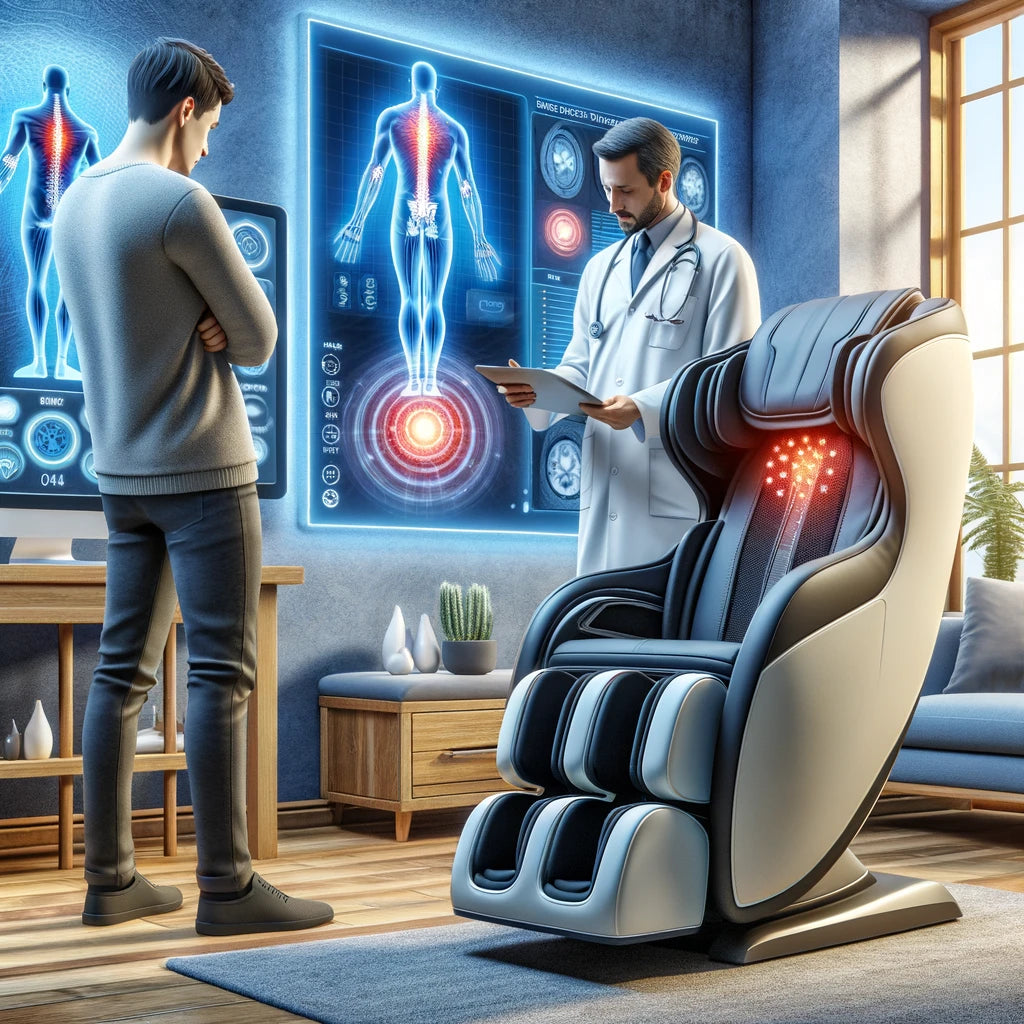



The ‘lymphatic drainage function’ of a massage chair is an air pressure or compression massage: air cushions around the feet, calves, arms and hips fill rhythmically with air and then release. It shares nothing with manual lymphatic drainage except the name. Manual lymphatic drainage is a therapy carried out by specially trained therapists, usually on a doctor’s recommendation or referral, for example for lymphoedema, and a chair does not replace it. A massage chair is a comfort device: many people find their legs feel lighter afterwards, for example after sitting or standing for a long time.
목차 보기
- 다음 기사: Massage chairs on Black Friday: how to spot a genuine deal
- 다음 기사: Best massage chair for you: six NAIPO models compared
- 다음 기사: Are massage chairs suitable for children?
- 다음 기사: Is back pain normal after using a massage chair?
- 다음 기사: Massage with a pacemaker: is a massage chair an option?
- 다음 기사: Is pain normal after using a massage chair?
What is manual lymphatic drainage?
Manual lymphatic drainage, or MLD for short, is a form of treatment used in physical therapy and is often simply called lymphatic massage. It goes back to the Dane Emil Vodder, who developed it in the 1930s.
The therapist works with slow, circular, pumping movements and very little pressure on the skin. The sequence is fixed: the areas close to the trunk, such as the neck, are treated first, and the therapist then works step by step towards the arms or legs.
MLD is carried out by therapists with specific training in the technique, for example physiotherapists or massage therapists with an additional qualification in MLD. It is usually given on a doctor’s recommendation or referral, and a typical reason is lymphoedema. A session generally lasts between 30 and 60 minutes. Whether and how the cost is covered depends on the health system of the country. In the UK, lymphoedema care, which can include MLD, is offered by NHS lymphoedema services, and MLD is also available privately.
For lymphoedema, MLD is often one part of complex decongestive therapy (CDT). This also includes compression bandaging or compression garments, skin care and exercises. This is also how a Cochrane review by Ezzo and colleagues from 2015 describes it.
What does the ‘lymphatic drainage function’ in a massage chair do?
The term almost always refers to air pressure massage, also called compression massage. There are air chambers in the foot section, the calf section, the armrests and at the sides by the hips. A pump fills them with air and lets it out again. The chambers wrap around the feet and calves, squeeze briefly and then release.
Some chairs work in a sequence from the bottom up: first the feet, then the calves, then the thighs or hips. This is reminiscent of the direction in which a therapist works on the legs. That is all there is to the name. The chair knows nothing about your condition: it runs a programme and works with air rather than with therapeutic hand techniques.
How the air cushions are built and how the intensity levels differ is explained in Air pressure massage in a massage chair.
What does compression massage feel like?
It feels like a firm, even squeeze, similar to a blood pressure cuff, only softer and in waves. On a low setting it is a gentle grip; on a high setting the pressure is clearly noticeable.
After a long day at the office, in the car or on your feet, many people find their legs feel lighter and more relaxed afterwards. That is a personal sensation, not a statement about any health effect. If you regularly notice swollen legs, have the cause checked by a doctor rather than masking it with a chair.
Many people find the compression particularly comfortable in a reclined position. In the zero gravity position your legs are higher than when you sit, and your body weight is spread across the whole surface. Whether this position is worth it for you is covered in Is a Zero Gravity massage chair worth it?
Manual lymphatic drainage or compression massage in a chair: what is the difference?
| Manual lymphatic drainage (MLD) | Compression massage in a chair | |
|---|---|---|
| Who | Physiotherapist or massage therapist with additional training in MLD | You, at home, using the remote control or tablet |
| How | gentle, circular hand movements in a fixed sequence, adapted to your condition | air chambers fill and empty according to a programme, intensity selectable in levels |
| What for | therapy for conditions diagnosed by a doctor, such as lymphoedema, often as part of CDT | relaxation and comfort, for example after sitting or standing for a long time |
| Cost and referral | usually on a doctor’s recommendation or referral; whether the cost is covered depends on the health system (in the UK: NHS lymphoedema services or private treatment) | you buy the chair yourself; no referral, not a medical treatment |
| What it cannot do | It is not a wellness treatment on demand and, for lymphoedema, does not replace the other parts of CDT | It is not a therapy, does not replace lymphatic drainage recommended by a doctor and does not treat any condition |
Medical devices for intermittent pneumatic compression (IPC) are a different matter. They use cuffs on the arm or leg with defined pressure settings and are used on the advice of a doctor or other healthcare professional. A massage chair for the home is not such a device.
Who should avoid compression massage?
Pressure from outside on the legs, feet and arms is not suitable for everyone. The following points apply to the air pressure massage of any chair. The instructions in the user manual of your model take precedence.
- Thrombosis (DVT) or suspected thrombosis: do not use. If one leg is swollen, warm or painful, see a doctor before you sit in any massage chair. In the UK, you can ask for an urgent GP appointment or call NHS 111.
- Acute inflammation or infection, for example erysipelas or cellulitis (bacterial skin infections) or a fever: do not use until it has fully cleared.
- Heart failure: only after talking to your doctor.
- Recent injuries and open wounds on the legs, feet or arms: do not put these areas under pressure.
- Pregnancy: only after talking to your doctor or midwife. More on this in Massage chairs during pregnancy.
- Pacemaker: follow the instructions of both the chair manufacturer and the pacemaker manufacturer. Background information is in Massage chair with a pacemaker.
- Lymphoedema: talk to your doctor or therapist first. Whether pressure from outside is suitable for you, and how strong it may be, depends on your individual condition.
If in doubt: ask first, then sit down. General advice on safe use can be found in Are massage chairs unhealthy?
What should you look for when buying?
If compression massage for your legs and feet matters to you, check these points in particular:
- Foot and calf cushions: Are there air chambers on the sole, at the heel and along the sides of the calves? More chambers distribute the pressure more finely, so the grip feels enveloping rather than pressing.
- Length of the calf section: The calf section has to match the length of your legs. Otherwise the cushion sits at the heel on tall people and at the knee on shorter people. An adjustable or electrically extending calf section solves this.
- Intensity levels: The air pressure should be adjustable in several levels so that you can start gently.
- Compression you can switch off: Ask whether the air pressure massage can be switched off for individual zones or completely. That way the back massage stays usable on days when you do not want pressure on your legs.
- Reclining and zero gravity: A continuously adjustable backrest and a zero gravity position make lying back for longer more comfortable. Some models offer two such positions.
- Timer and programme length: A fixed timer stops you from accidentally staying in the chair for too long.
Which NAIPO massage chairs have air pressure for the legs?
You will find a selection in the category massage chairs with a lymphatic drainage function. Three examples with a different focus:
- NAIPO A350 PRO Massage Chair: 24 airbags for the arms, shoulders, hips, calves and feet, plus an electrically extendable calf section with a kneading function and 15 automatic programmes. A good fit if air pressure massage for the legs is your priority.
- NAIPO Massage Chair Model P: capsule design with shiatsu, kneading, tapping and air pressure, two zero gravity positions, three intensity levels for the foot rollers and a body scan before each session.
- NAIPO Premium Massage Chair Space-Saving: shiatsu and air pressure with eight air cushions at the lower back, seat and legs, in a slim design with a reclining function and a 15-minute timer. For rooms where there is no space for a capsule chair.
You can compare all models under Buy massage chairs.
How long and how often should you use the function?
15 to 20 minutes per session is a sensible guide. That is also how long the programmes of many chairs run; the NAIPO Premium Massage Chair Space-Saving, for example, switches off after 15 minutes. Longer is not better.
Start on the lowest pressure level and only increase it once that feels comfortable. If the pressure becomes uncomfortable, or your feet tingle or turn cold, stop and choose a lower level next time. If such sensations persist afterwards, have them checked by a doctor.
How often you use it is up to you and how you feel. Many people use the function in the evening after a long day. If you are being treated for a problem with your legs, discuss using the chair with your doctor or therapist first.
Where can you try compression massage?
You only find out how the pressure feels on your own legs by sitting in the chair. You can try NAIPO massage chairs at partner locations across Europe. The store locator lists them and explains how to become a partner location.
When you try a chair, set aside a few minutes just for the foot and calf section, starting on the lowest level. The points in the buying checklist above help you compare models.
What can’t a massage chair with a lymphatic drainage function do?
It does not treat any illness. It replaces neither manual lymphatic drainage recommended by a doctor nor compression garments nor the other parts of decongestive therapy. Claims about effects on tissue, skin, the body’s defences or hormones are not supported by evidence for massage chairs, and we do not make them.
What it offers is comfort: a massage for your back, legs and feet at home, at a time that suits you, and for many people the feeling of lighter legs after a long day.
Source: Ezzo J, Manheimer E, McNeely ML et al. (2015): Manual lymphatic drainage for lymphedema following breast cancer treatment. Cochrane Database of Systematic Reviews, CD003475. doi.org/10.1002/14651858.CD003475.pub2
자주 묻는 질문
Do not use it if you have thrombosis or suspected thrombosis, an acute inflammation or infection, or on areas with recent injuries or open wounds. If you have heart failure or are pregnant, use it only after talking to your doctor. With a pacemaker, follow the manufacturers’ instructions. More in the section Who should avoid compression massage?
You can try NAIPO massage chairs at partner locations across Europe. The store locator lists them and explains how to become a partner location. You will find a selection of chairs with air cushions for the legs and feet under massage chairs with a lymphatic drainage function.

NAIPO 편집부 작성 · Hamburg의 마사지 및 제품 전문가들
Alsterwell GmbH의 제품 전문가, 서비스 기술자 및 마사지 애호가들 — 10년 넘게 마사지 기기에 특화되어 왔으며, 자체 작업장과 체험 시트가 마련된 쇼룸을 운영하고 있습니다.
전문 검토: David Eberst · NAIPO의 공동 창업자


댓글 남기기
이 사이트는 hCaptcha에 의해 보호되며, hCaptcha의 개인 정보 보호 정책 과 서비스 약관 이 적용됩니다.